
For as much satisfaction as I gain from providing meat for my family, it’s not always a lighthearted task. Over the years I’ve come to realize that there’s more thoughtfulness and reflection during the act of dispatching an animal than at any other time in my life. I find that as I go through the process, I often get lost in my thoughts as I try to figure out what emotions I’m feeling. I don’t know if I will ever have enough experience to put it into words how it makes me feel. Often when we say that we enjoy doing something it’s synonymous with saying that we find a task to be fun. There is nothing fun at all about killing an animal. In fact, as I am getting to the moment that it’s time to actually take a life, it’s terrifically upsetting. But this is where there aren’t words to describe what all the feelings are like. It’s upsetting, but not sad. Enjoyable but not fun. There’s a feeling that is reminiscent of an adrenaline rush, but adrenaline is sort of like the low hanging fruit of emotions that comes from cheap thrills. This feeling is much deeper and intense than that.
I know that it’s unrealistic to convince every meat eater in the world to participate in a processing day, but I do think that more people should experience it. Maybe some people would find a similar interest as mine and surely some others would actually realize that they can’t handle the emotions and perhaps stop eating meat. Either way, you learn something about yourself and your food supply if you get involved even in a minor way.
As I have experienced this more and more, I have made a conscious decision to embrace the whirlwind of emotions. I don’t want to ever have a hollow feeling or a numbness to the process. I worry that if I ever were to feel a nothingness, that it would be a sign of myself not recognizing the value of life or of not respecting the tremendous weight of the sacrifice that the animal made for us. I don’t want to ever stop recognizing that taking an animal’s life for meat is a burden. I think if I didn’t have these feelings, I would actually have to make the decision to stop eating meat myself. Instead of pushing those emotions down and suppressing them, I try to spend time analyzing what they are and doing so helps to provide some kind of clarity to what I want in the world.
This train of thought is what really solidified my desire to raise meat. I can remember the first two goats that I harvested and just how much weight of pressure I felt in the moment. At the time, I thought I would feel nothing and that it would be easy. I felt like that moment and the lasting impact that I felt for the next few days really sparked a change in the way I view life. It felt important to me to continue to explore what that was.
One of the more interesting things that I’ve come to realize is that the method of the harvest and the type of animal really changes the emotional aspect of the moment. You might assume that a farm animal that was raised for meat would automatically be simpler than harvesting something like a deer, but in reality, I have found that harvesting ducks and goats is more of a struggle mentally than pigs, chickens, or wild game. For ducks and goats you are handling them, calming them down, and then the act of taking the life is very personal with a knife to the throat. Although a chicken still has the same type of personal dispatch method with a knife, chickens, in my experience, calm down the second you pick them up and they’re not nearly as smart, nor do they have as strong of a will to live. Not to say that there isn’t the same sort of emotional aspect, but it’s easier when a chicken acts like it knew all along that it was destined for meat and had accepted it long ago.
I find deer to be much more interesting for this side of things where there really isn’t the same sort of personal connection, especially when you’re using a rifle from hundreds of yards away. This is partly why I prefer to hunt with a bow because it is more of a challenge and at some point when you’re out there with the deer, you start to feel like you understand them better and you gain a level of respect for them and their struggle as a prey animal. But even still, most of the connection and emotion actually comes from the stalk and the interactions with the deer, not so much from the moment of pulling the trigger or letting an arrow fly.
Perhaps the most important thing to feeling good about and accepting your actions on this side of things is to make sure that the animal was raised well without stress and that the end is clean, efficient, and calm. I think that when you do this, there is a sense of reward when you eat the meat. A well raised and processed animal will taste good and be nutritious. It’s as if the animal is saying thanks to you for giving it a good life and is giving you permission to nourish yourself, whereas a poorly raised and processed animal will taste bad and potentially make you sick, thus getting back at you and serving you right for not fulfilling your responsibilities as their caregiver.
Duck Processing Day
*Warning- Following post has images of animal processing that might be upsetting to some people*
Yesterday was the day that the burden of abundance caught up to us and it was time to harvest 12 of our Muscovy ducks. For the first time, I had someone with me who wanted to learn about the process. It was rather interesting to find myself acting as a teacher and to see the reactions of a first timer and to hear their thoughts. It was also the first time that my son witnessed the dispatch. Every time up until yesterday that I harvested ducks, I made sure he wasn’t around. I thought that I was protecting him from something that he wasn’t ready to see, but in fact I came to realize that I was protecting myself from having to deal with explaining to him how important it is to respect and care for these animals. Young kids can deal with, understand, and accept far more than we often allow them to and he showed me that yesterday as we talked through everything that happened.
The day started off with corralling the ducks that were to be culled. I had a mixture of drakes and hens. It’s important to me that the ducks stay calm throughout the day so I corralled them as gently as I could into a very large dog crate which I put a tarp over. Just like most birds, if there’s a tarp over the ducks, they stay calm and quiet.
After gathering the ducks it is time to begin dispatching. I have tried several different methods and the way I do it now is what I have found to be the best from both an ethical perspective and a culinary perspective. Firs the ducks are turned upside down and restrained in a cone. I prefer to talk to the duck and cover their eyes and you can see a moment of acceptance and relaxation at this point. I use a method called pithing which involves taking a sharp object (I use a nail hammered through a piece of wood to be a handle) and inserting it through the back of the skull to immediately obliterate the brain and end all cognitive ability instantly. Immediately after pithing, I insert a sharp knife point into the mouth to cut the arteries on either side of the roof of the mouth to remove all the blood. Meat can’t bruise in the plucker if there is no blood so bleeding is a very important step. If you’re wondering why you wouldn’t just cut the head off, the two reasons I have are that a.) I’ve seen instances where people go to cut, the bird moves, and the bird gets injured instead of killed and b.) the head makes great stock and keeping the neck skin intact allows for some protection against ripping during plucking and the neck skin can be saved to stuff like a sausage casing, but is far more delicious than any casing. Just slitting the throat is another common method that I don’t recommend because it damages the skin and even when there’s rapid blood loss, ducks don’t actually die very quickly. If the duck blinks when you touch the eye, you know there is still brain function. With my method, all brain function and pain is gone instantaneously.

Ducks are notorious for being among the most difficult (if not THE most difficult) animals to process for homesteaders. To effectively pluck a duck, you need to scald the exterior in hot water (I target 149 degrees in a turkey fryer). The problem here is that ducks have evolved to essentially be waterproof. They have a lot of feathers with a lot of oil that doesn’t allow water to get all the way down to the skin. Where a chicken can be properly scalded in as little as 15 seconds, a duck can take up to 2 minutes. In a typical home setting, getting the scald evenly across the entire body can be rather challenging. Every processing day I try to make a little bit of improvement over the previous one and yesterday my big improvement came from dunking the duck, lifting it all the way out of the water for about 5 seconds, and re-submerging and repeating until the feathers pulled away easily. I was trying to emulate the way that a commercial processor uses a rotary scalding bath. In doing so, it was easy to prevent over scalding areas and accidentally cooking the skin.
If you’re just processing a couple ducks, after scalding you can pluck by hand or use a drill attachment with plucker fingers. With the amount of ducks that I pluck each year, I bought a tub style plucker machine that spins the birds around and plucks the feathers off, rinses the skin, and discharges feathers into a neat pile out of a chute on the bottom of the plucker. It is a massive time saver. Ideally at this point the duck looks properly plucked with just a few feathers, normally on the back and around the wings. To finish plucking, dip the duck in a pot of boiling hot wax, submerge in ice, and repeat twice for a total of 3 wax dips to form a hard shell. Then, leave the duck in ice for at least 5 minutes, peel the wax shell off, and the duck should be fully plucked and clean.
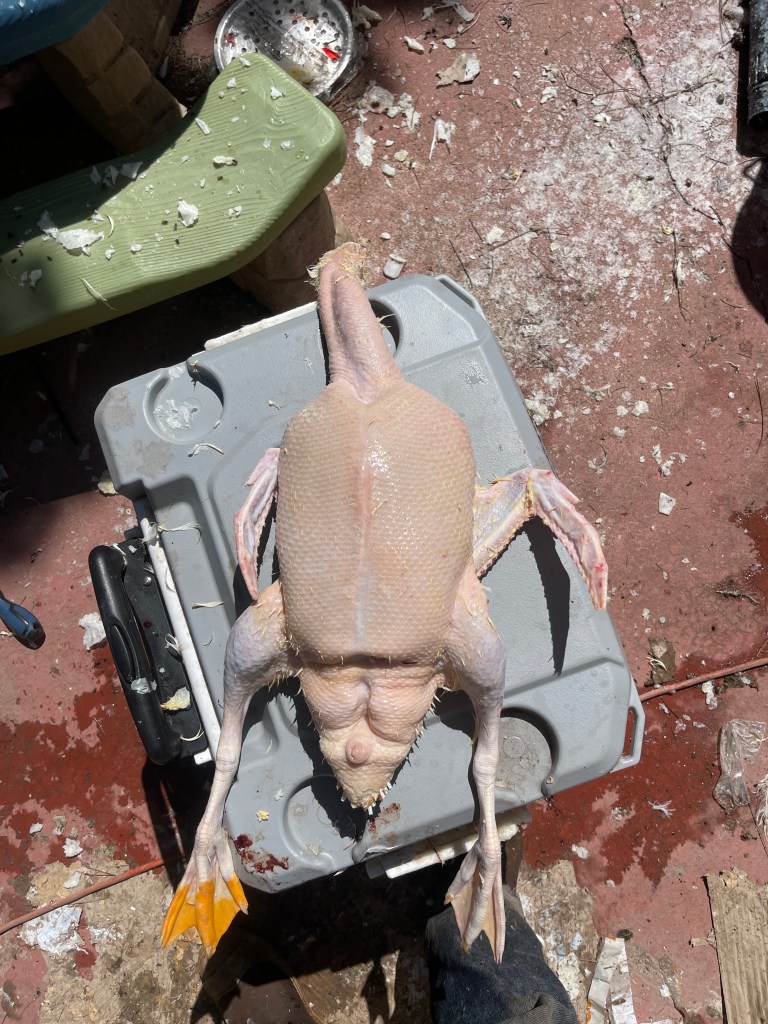
From there it’s time to eviscerate. This is a step where a large number of people are wasteful. Heads, necks, and feet should be saved at least for stock. The tongues should be saved separately from the head for stir fry or for a kind of noodle substitute in a pasta. Livers can make the most beautifully rich pate and the hearts have all the flavor of the breast meat, but it’s like it’s concentrated to double the amount of flavor. Skewered and grilled duck hearts with a soy sauce glaze is a real treat to experience. Any fat on the inside cavity of the bird should be collected and rendered for use as an ultra premium, tasty cooking oil.

The ducks that I harvested were all black and pied Muscovy ducks. These ducks were not selectively bred for meat development. I wanted to compare the weights of these ducks at 12 weeks with my French White Muscovy ducks that have superior meat raising genetics. It was shocking how different the weights of these ducks were compared to what I’m used to. A typical French White Muscovy drake has dressed out at around 10 lbs for me. These little guys ranged from 4.4 to 5 lbs. The hens were as small as 2.5 lbs. Disappointingly, after looking at the amount of feed consumed by the black and pied ducks, they ate nearly as much feed as the French Whites which means that their feed conversion ratio was pretty terrible. I held back 2 drakes to raise to 6 months old to see how much weight gain there will be from here on out. The drake that was used to breed these ducks dressed at 8 lbs as a 7 month old. In reality, I don’t think I’ll continue to breed these ones since I have French Whites for better meat production. The hens will be crossed with a French White drake this Spring so that I can observe the weights of the crosses and see how much closer we get to good meat genetics, but I’d be lying if I said these results weren’t a bit disappointing. Stay tuned for ideas on how to use all the different parts of the duck!


 raisedincochise.com
Leave a reply to Robert Elliott Cancel reply